


Good Afternoon.
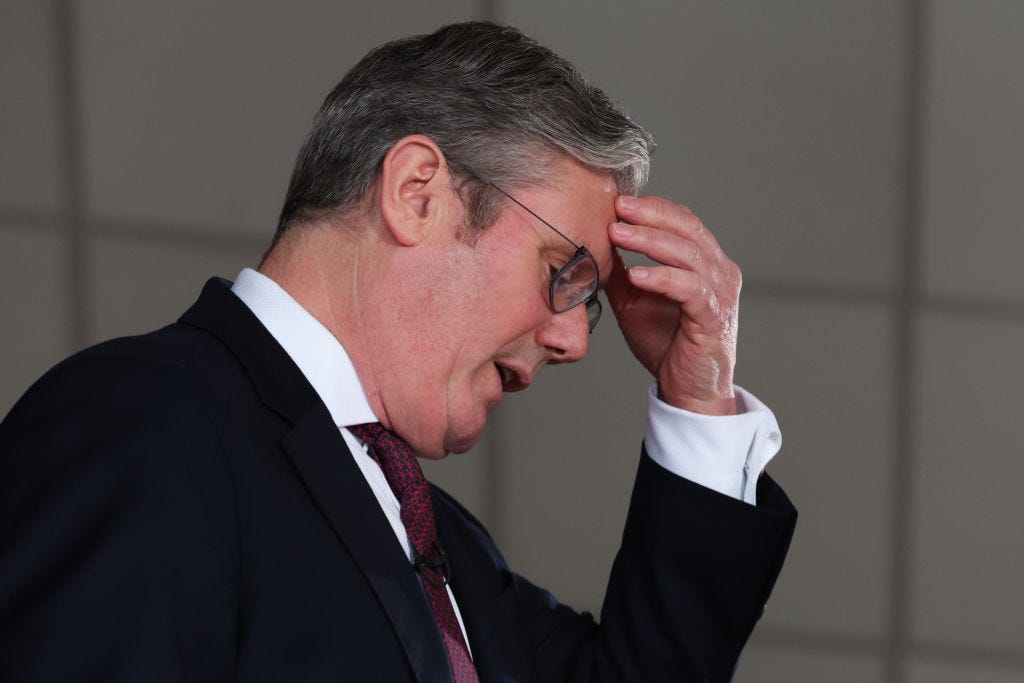
By the time the lectern was carried out onto Downing Street this morning, most of Westminster already knew what was coming. Keir Starmer stood in front of that famous black door, his voice catching when he spoke about his wife and children, and announced that he is resigning as leader of the Labour Party and as Prime Minister. He will stay on as caretaker until his party settles on a successor. Less than two years after one of the largest landslides in modern British political history, the government he built has run out of road.
This is not a small moment. He becomes the seventh person to stand outside that door and announce a premature departure in roughly a decade. The country he leaves behind is exhausted by the churn.
What actually happened
Starmer spoke to King Charles this morning before making the statement public, which is the constitutional courtesy that signals a decision is final rather than a threat. He framed it carefully. The question his party had started asking, he said, was whether he was the right person to lead them into the next general election. He told the cameras he had heard the answer and accepted it with good grace.
The collapse had been building for months. Labour lost more than a thousand council seats in the May local elections, and the result was read across the spectrum as a straightforward verdict on his leadership. Around twenty ministers walked during his tenure. Reform UK has been leading the national polls with unsettling consistency, the Greens have been quietly peeling off the disillusioned left, and the appointment of Peter Mandelson as ambassador to Washington dragged the Epstein story back into the headlines at the worst possible time. The final push came last Friday, when Andy Burnham won the Makerfield by-election and returned to Parliament with the open intention of taking the top job.
Here is the timetable that matters for the weeks ahead:
Nominations open on 9 July and close when Parliament rises for summer recess on 16 July.
If more than one candidate clears the threshold of twenty percent of Labour MPs, a vote of the wider membership follows.
In the event of a contest, a new leader is due to be in place by 1 September.
Starmer remains Prime Minister throughout, with a promise of an orderly handover.
Why he really lost the country
The temptation today will be to write Starmer off as a man who simply failed at the job. That reading is too easy, and it misses the more interesting and more useful lesson.
There is a genuine case that not everything was going wrong. His handling of foreign affairs earned real respect, including from people who disliked almost everything else about him. His refusal to be dragged into the Iran war was described even by his critics as brave and principled, and the tributes pouring in from European leaders this morning are not the kind you write for a man who achieved nothing. Some of the harder economic numbers were arguably beginning to steady. On paper, the story of his premiership was not the unbroken disaster the headlines suggest.
The problem is that almost nobody could tell you what he was for. He won an enormous majority on the promise of competent, grown-up government after years of chaos, and then he governed as though competence alone would speak for itself. It does not. Voters do not experience spreadsheets or quarterly growth revisions. They experience a feeling about whether the country is going somewhere, and whether anyone at the top can describe where that is. Starmer never gave them that feeling, and a government that cannot explain itself gets no credit for the things it quietly gets right.
That is the part worth holding onto, whatever you think of his politics. Leadership is not only about doing the work. It is about giving people a story they can stand inside while the work gets done. Starmer had the first half and almost none of the second, and in the end, the silence was filled by everyone else.
The succession is moving fast
Attention has already shifted to Andy Burnham, who confirmed this morning that he will put his name forward and called for the process to be conducted in an orderly and responsible way. He is the overwhelming favourite. Wes Streeting, who resigned as health secretary last month and looked like the most credible rival, has thrown his weight behind Burnham instead, which clears the field considerably. If no serious challenger emerges, Labour may opt for a coronation rather than a contest, and Burnham could be Prime Minister within weeks.
The sensible thing is to watch two things at once. The first is whether Burnham’s brand, built in Manchester on a kind of plain-spoken distance from Westminster, survives contact with Westminster itself. The second is the uncomfortable fact that the country is about to get its next Prime Minister without anyone outside the Labour Party casting a single vote. Some will say that is exactly how the system is meant to work. Others will say it is precisely the churn that has hollowed out public trust in the first place. Both have a point, and the next few weeks will tell us which instinct is winning.
Mike Omoniyi
One more thing before you go
Away from the politics, we have a new episode out this week that we are genuinely proud of. Mike sits down with Sharon Foulston for a conversation about inheritance, grief, and what she learned sailing solo across open water with nothing but time and her own thoughts for company. It is honest, unhurried, and a useful counterweight to a news cycle that moves this quickly. Have a listen when you get a moment, and let us know what lands.
We will keep watching the leadership story closely and bring you the parts that actually matter, without the noise.
Stay sensible.
Calaudia,
Community Manager